The King of the North According the Bible Fantasy Art the Bear
Final Fantasy [ ]
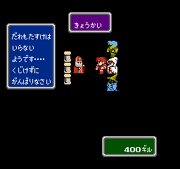
A church.
In the original Japanese Famicom version, many of the towns contained churches, known equally "Clinics" in the North American NES version due to Nintendo of America'due south policy on religious references. The churches have a cross on the steeples, and are run past priests that wearable outfits like to the Pope. Other religious references in the Japanese version are the add-on of Star of David replaced with unlike imagery in the crystal rooms of the Four Fiends, as well equally crosses that lead upwards to Bahamut. The game's main antagonist, Chaos, is based on the Devil/Satan from Abrahamic religions.
Terminal Fantasy II [ ]
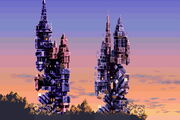
Castle Pandaemonium.
Terminal Fantasy II alludes to the Abrahamic religions, as towards the stop the party travels into Pandaemonium, the palace of Hell depicted in Paradise Lost. In Pandaemonium, the political party encounters several demons from demonology, like Beelzebub and Astaroth. In Soul of Rebirth, the party travels to Araboth, the highest heaven which contains the throne of God. While not in the game itself, the novelization Concluding Fantasy II Muma no Meikyū indicates the Emperor had sold his soul to Satan for his magical powers.
Although not in the game itself, the FMV opening for the PlayStation version has a church steeple collapsing during the Empire'due south attack.
The Emperor's Japanese name, Kōtei, is an allusion to the legendary monarch in Chinese mytho-historical tales, including the Three Sovereigns and Five Emperors, and the Cosmological Five Forms of the Highest Deity, known every bit the Yellow Emperor. He is purported to exist the ancestor to all the Chinese and the initiator of the Chinese civilization, as well as being accredited to various inventions, including football and the calendar.
Final Fantasy 4 [ ]

Tower of Babil.
The Tower of Babil refers to the biblical Tower of Babel (מגדל בבל Migdal Bavel) congenital by a united humanity with the intention of reaching the heavens. The Tower of Babil houses the Behemothic of Babil, a swell power from the moon, and both God from the Genesis story and the Behemothic of Babil had the intention of "confounding" humanity.
Kain Highwind's name is from the Genesis story of Cain and Abel (קין והבל, Kayin v'Hevel), in which Cain, in his jealousy of his brother, betrayed him by slaying him. This is reflected in Kain repeatedly betraying his adoptive brother, Cecil Harvey (coincidentally to Cecil's real brother, Golbez). Kain's ultimate weapon is Abel'south Lance, a biblical innuendo to the story of Cain and Abel.
The concept of yin and yang may exist represented by Palom (a Black Mage) and Porom (a White Mage). The concept of yin yang says the two depend on one another, perhaps shown in the twins' power, Twincast.
In western culture, white and blackness traditionally symbolize the dichotomy of practiced and evil, equally seen in the elements of Holy and Dark, and Cecil's progression from a Dark Knight—wearing black armor and wielding Dark elemental weapons—to a whiteclad Paladin with White Magic abilities.
When the SNES version was released outside of Japan, several changes were made, such as the Belfry of Prayers being named Tower of Wishes, and the removal of Rosa'southward Pray ability. The Holy spell was renamed to "White". A new save point graphic was fabricated for the Sylph Cave and Land of Summons' salvage points that were changed from a Star of David to a tile with an "S" marked on information technology.

The Star of David also appears for the Dispel graphic in the Super Nintendo version; in subsequent versions, information technology was modified to an octagram.
Final Fantasy Six [ ]
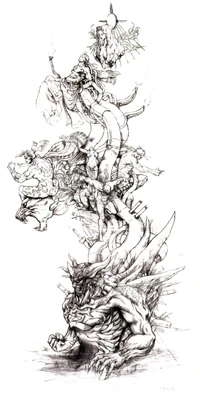
Kefka'due south final battle with the Returners mirrors the Divine One-act, which entails Dante's journey from Hell, to Purgatory, to Heaven, and eventually meeting God face-to-face up where He tells him the significant of life.
The first tier of the Statue of the Gods consists of Long Arm, Short Arm and Visage, which is based on Dante's journey in Hell. Visage represents Satan in the middle of Hell, as Satan was depicted as a demon entrapped up to the waist in ice, which may explicate Visage'southward weakness.
The second tier represents Purgatory in Divine Comedy, where souls suffer if they had committed any of the Seven Deadly Sins until they are spiritually purified.
The third tier represents Paradise or Heaven. The Balance and Lady portions of the final battle with Kefka are based on the Pieta statue, depicting Mary property Jesus before long afterward he died on the cross. Information technology is further alluded to in the Japanese version, where Lady's proper name is Maria.
At the end of the journeying, Dante meets God in the Empyrean, which the background for the last battle against Kefka represents. Kefka'south terminal grade resembles the devil with a pair of angel wings and a halo.
The original proper name for what is afterward referred to as Heartless Angel, Fallen One, alludes to a name of i of the fallen angels, Match, better known equally Satan or the devil.
When trying to convince Terra to support the Returners' cause, Banon speaks of a box someone opened that unleashed the evils of the world, but independent within it a single ray of light, hope, and asks her to be their promise. This alludes to the Pandora's box of Greek mythology where Pandora was given a beautiful container and told to non open it, but was compelled by marvel. When she opened information technology, all evil contained escaped into the world, just at the bottom of the box remained a Spirit of Hope named Elpis.
Christian crosses tin can be seen carved on tombstones in the graveyard in the town of Thamasa, including the memorial of "General Leo".
Final Fantasy Seven [ ]
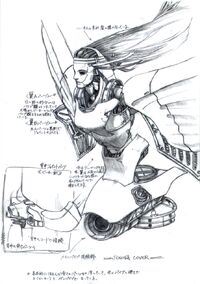
Final Fantasy 7 draws from the Lurian Kabalā (Jewish Mysticism), a medieval Jewish variant of Gnosticism. Gnosticism originated equally a Roman-era fusion of Christianity and Ancient Greek philosophy, and its adherents were said to have knowledge of the "true" nature of the earth.
Like the Cetra, the Gnostics were persecuted until their behavior died out, though traces remain in the Kabbalah, Sufi Islam, and Jungian psychology (which also relates to Cloud'south journey into the Lifestream to face up the buried shadow aspects of his mind). Hojo'south Reunion Theory, where entities infused with Jenova's cells will reunite with Jenova/Sephiroth at the North Crater, stems from Gnosticism, namely the concept of each human having a fragment of God.
Both belief systems, Gnosticism and its Kabbalist branch, proclaim that all humans have inside their bodies a spark of divine light from the Absolute, which returns at that place upon death. This Absolute is an infinite wellspring of spiritual energy, knowledge, and goodness, mirroring the function of the Lifestream. The Kabbalah states the Absolute is the Judeo-Christian God, whereas early Gnostics believed him to be an incompetent or malicious simulated god known as the demiurge ("artisan" in Ancient Greek) who merely believed himself the uncreated deity because he was shielded from the Absolute by his "mother", an emanation from the Absolute (known equally an Aeon) who fell from the skies. This demiurge, trapped in the textile world, cannot create anything good, and instead corrupts the sparks of light, just like Jenova'southward corruption of the Lifestream and of homo beings.
The name Jenova has Hebrew and Latin components. One is taken from the ineffable Hebrew name of God, יהוה (yud-hei-vav-hei), often romanized into Yahweh or Jehovah, although the original pronunciation is no longer known. This is combined with the Latin word nova, meaning "new". Thus Jenova is, in a sense, a "new god", similar the demiurge when created by his female parent.
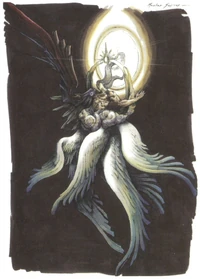
Equally Jenova is Sephiroth's "female parent" however is also implied to be about ane and the same, their human relationship is similar to the mainstream Christian view of Jesus Christ's human relationship with Jehovah, as he is considered both the Son of God and Son of Man. Depending on how one counts the Remnants' and Sephiroth'south will, this also alludes to the Holy Trinity, the "Male parent, Son, and Holy Spirit" in Christian dogma.
Sephiroth factors in through Kabbalism. His name is Hebrew in origin (ספירות Sfirót) and means "counting", or "enumeration". This aspect can be compared to the Sephiroth Clones, who are each given a number. The 10 aspects of God and creation known as Sephirot (aforementioned as the Gnostic Aeons) are often arranged in a unique design known every bit the Tree of Life. These aspects are "Crown, Wisdom, Agreement, Benignancy, Force, Dazzler (known in Hebrew as "Tifaret"), Eternity, Splendor, Foundation (Vessel) and Royalty (Kinghood)", though some lists differ slightly.
Sephiroth summons Meteor to create a wound to the Planet, thereby condensing the Lifestream at the impact site to allow him to ascend to Godhood. It is said in the Zohar that "If one tried to pour all of infinity into a vessel, the vessel would break." Information technology would crack, and the universe would rupture into a flowing, yet familiar design (the Tree of Life). This principle would too apply to Ultimecia's desire to unite all of existence and reform information technology to her liking in Final Fantasy 8.
In Sephiroth's rebellion he tries to capture the Promised Land, a heavenly place of myth, for himself. The Promised Land is based on the Biblical tale of Moses where he was ordered by God to atomic number 82 the Israelites out of slavery to a land which God promised that they'd discover. Due to their disbelief they never constitute it, and traversed the middle-east for twoscore years.
His final form, Safer∙Sephiroth, may be based on Biblical descriptions of a Seraph. In Isaiah half-dozen, the Seraphim are described every bit Celestial, half dozen-winged beings that circle the throne of God. However, the origin of the name Safer∙Sephiroth is Hebrew; the dominate's proper name equally written in Japanese is (セーファ・セフィロス, Sēfa Sefirosu ?); "safer" can also be transliterated every bit "sefer", "sapher", and "sepher". "Sepher" (סֶפֶר) is Hebrew for "book"; thus, Safer Sephiroth (Sefer Sfirot) translates to "Book of Numerations". Thus it may too refer to the 10 Kabbalistic Sefirot, the ten aspects of creation according to Jewish Mysticism.
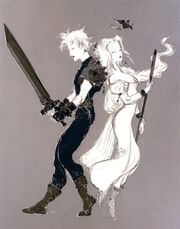
Cloud and Aerith.
Sephirot are the ten attributes through which God appears, and Aerith may be tied to one such attribute, chesed, meaning kindness or love. Information technology is a virtue which contributes to a concept translated as the healing of the world and the concept suggests man's responsibility to repair and transform the earth. The Talmud says "the Torah begins with chesed and ends with chesed", and Aerith is the first and concluding character seen in the main events of Final Fantasy 7 (excepting the epilogue). Those who embody chesed go "above and beyond that which is normally required", and chesed is the first of the sephirot of the attribute of activity; in other words the initiation of activity. This is similar to how Aerith ventures off alone to summon Holy. The gematria (a numerological system for assigning numbers to words) of chesed is 72; Aerith's birthday is the seventh of February.
In similar vein, Barret may be tied to gevurah, associated with judgment and strength. From the Bahir, "This is the left hand of God." The right hand of God being chesed. Cloud, Barret and Aerith were the starting time role player characters designed for the game, with Aerith and Barret perchance representing chesed and gevurah. The metaphor may be embodied in Barret, who has lost his correct hand, but retains his left.
Aerith grows flowers in an abandoned church in the Midgar Slums reminiscent in construction to a Catholic or Lutheran church. The flowers grow from a pigsty where the pulpit would have stood. Aerith is office of a race able to talk to the Planet. A similar concept of a "chosen people" being able to speak to God is present in Judaism and Christianity, and the Pope is supposedly chosen to evangelize God's will to the world. Sephiroth holds a similar, though much darker, belief almost himself existence the chosen one, chosen to rule the Planet. The connection is strengthened when Aerith prays at an altar to become the Planet to cast Holy. After her death, she travels through the Lifestream, easing the passage of departed souls, and working against Sephiroth. As such, she can be likened to Jesus Christ, a saint, and/or a guardian angel, although angels traditionally are not born of the souls of the departed.
Tifa's bar, 7th Heaven, is named for a concept in both Jewish and Gnostic belief, whereby the Throne of God is located higher up the seventh circle of heaven. Tifa herself is possibly named subsequently a concept from the Judeo-Gnostic Kabbalah, the "Tiferet", the emanation of God concerned with dazzler and forcefulness.
The Jenova-mutated form of Hojo, Helletic Hojo, is a misromanization of "Heretic Hojo", referring to Heresy, a concept in diverse religions where people translate behavior in a religion that goes confronting the norm of the faith.
Fenrir from Advent Children.
Final Fantasy VII holds many references to Norse mythology, particularly in names. Midgar comes from Midgård, the Realm of Mankind, and is depicted as the nigh avant-garde city in the world in terms of engineering and human being-made devices. Nibelheim comes from Niflheim, the realm of mist and darkness, where Hel, too called Helheim, is located. Helheim, a Norse underworld, is ruled by the goddess Hel, who was the sibling of Fenrir. Fenrir is a hell hound known for his cracking strength, and during Ragnarok, the event that would herald the end of the world, he would rise up and kill Odin, the king of the gods. In Terminal Fantasy VII: Advent Children Cloud is associated with Fenrir, a wolf, which is as well the proper name of his motorcycle. Cloud is notable for his forcefulness, was born and raised in Nibelheim, and the one to strike down Sephiroth who wanted to become a god after arresting Jenova's cells and the cognition of the Lifestream. This result draws parallels with Ragnarok, as the Meteor was about to destroy the Planet had Cloud and his friends not intervened to end Sephiroth. However, in the myth, Fenrir is killed as retribution past Odin's son Vidar.
The Lifestream is similar to Abrahamic descriptions of Heaven, as it houses the secret to eternal life. The Lifestream is constantly flowing and changing, but never disappearing. Past joining it, people are returned to a land of innocence, where all that remains are God and His garden. The Lifestream is also similar to Japan'due south ethnic religion, Shinto, which purports that all things have souls. In Final Fantasy Seven, all living things have souls, which contribute to the overall soul of the Planet later on they depart and "Return to the Lifestream". The Planet breeds new life from this soul in a process similar to reincarnation, although in Hinduism, the individual soul joins the overall soul merely upon reaching enlightenment.
The monster Skeeskee, which has a somewhat hellish appearance, grants 222 EXP upon defeat and e'er appears in groups of three, for a total of 666 EXP. In the New Testament, 666 was described as "the number of a homo" associated with the beast, and in popular culture is known every bit a symbol for the Antichrist or the Devil.
Crisis Core -Concluding Fantasy Seven- [ ]
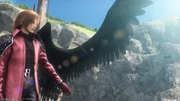
Genesis and his blackness wing.
Angeal Hewley sprouts 2 white feathered wings similar those of angels equally they are often depicted. His first proper noun is a respelling of the word "angel". Angeal having ii white wings is done in contrast to Genesis Rhapsodos. Having two white wings makes him more alike to a heavenly angel, while Genesis has one blackness wing, representing fallen angels.
Genesis is named after the Biblical business relationship of creation and has a black wing much like Sephiroth. He is often seen offering a Banora White apple to people he wishes to join him, a reference to Adam and Eve in the garden of Eden where the possessed serpent tempted them to eat a fruit containing cognition of Adept and Evil. Similarly, Genesis was the kickoff to learn about the "sin" of the Jenova Project, merely unlike Sephiroth, he achieves conservancy, as well as spiritual and concrete healing, from the Gift of the goddess.
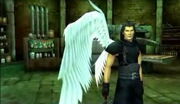
Angeal and his white wing.
Angeal Penance uses attacks named afterwards the Seven Deadly Sins, a part of Christian ideals and the Catholic culture: Defense of Lust, End of Gluttony, Accuse of Greed, Rage of Sloth, Unleashed Wrath, Thunder of Envy and Wings of Pride. Penance is the repentance of sins besides as the proper proper noun of the Roman Catholic, Orthodox Christian, and Anglican Sacrament of Penance and Reconciliation.
Minerva's presence every bit the personification of the Lifestream reflects the function of Sophia in Gnostic belief, an Aeon made from the pure energy of the divine realm of light known as the Accented, who was fragmented and trapped inside the bodies of human beings. The name Minerva is the Roman name of Athena, the wise Greek goddess of war strategy and crafts, a play on the proper name Sophia pregnant "wisdom" in Greek.
Final Fantasy VII: Advent Children [ ]
The title refers to the Christian belief in the advent, or 2nd coming of Jesus Christ to restore life and take the pious to the Kingdom of Heaven. The plot focuses on the inevitable rebirth of Sephiroth and the collection of those infused with Jenova cells into the Lifestream so he may have control of the Planet.
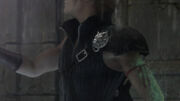
Cloud's Geostigma healed by Aerith'due south Great Gospel.
Deject seeks forgiveness regarding Aerith'south and Zack's deaths and cure his Geostigma. This mirrors the Christian belief that for one to be forgiven of sins, they must present themselves before God/Jesus and ask for forgiveness, the ultimate reward being "Eternal Life". That "Eternal Life" attribute is Cloud being cured of the fatal disease and being forgiven. At the stop Aerith cures everyone's stigma via the Great Gospel. This is taken from the Christian premonition that when Satan has risen to power and the globe is at its worst (Sephiroth has returned and the world is suffering from the stigma), Jesus will nowadays himself and heal those who believe in him of their sins.
The additions of "stagnant Mako", which brand upwards Chaos, and "negative Lifestream", controlled by Sephiroth, imply a sort of Hell or karma to the story'southward reincarnation system. It most closely resembles Hell in Hoshi o Meguru Otome, where souls who don't move on are said to be suffering, in this case of their own grief and regrets. Wailing emanates from the stagnant Mako. Thus, Sephiroth's "negative Lifestream" alludes to Abrahamic descriptions of Hell, as it reflects the belief of an evil existence, such as Satan, who corrupts humans and reaps their souls when they die.
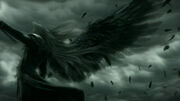
Sephiroth'south black wing.
Sephiroth sprouts a unmarried black fly during his battle with Cloud, which was retained from his Safer∙Sephiroth form. It is meant to symbolize him every bit a fallen angel, specifically Lucifer, equally fallen angels are often depicted with black wings in art. This is conducive with his Hades-like role in the film.
The scene where Kadaj, Loz, and Yazoo infect the children with black h2o containing negative Lifestream is similar to a Christian baptism, though darker, and peradventure Satanic. Cloud curing Denzel'south Geostigma through the pool of h2o in Aerith'due south church is too similar to a Christian baptism in the proper name of Jesus. This defies Kadaj's "negative" baptism, which just took control over the children, just did not cure them. This relates to faith in Christian doctrine, showing that its practices are but beneficial when performed correctly and for the right reasons.
Dirge of Cerberus -Final Fantasy VII- [ ]
Vincent Valentine'south primary weapon in both Advent Children: Concluding Fantasy Seven and Dirge of Cerberus -Final Fantasy VII-, the three-barreled Cerberus handgun, refers to the three-headed guard dog of Hades in Greek mythology. His other weapons, Hydra and Griffin, besides refer to creatures of Greek mythology.
Weiss'south subtitle, the Immaculate, as well as his being built-in untainted past the negative Lifestream, alludes to a concept in the Catholic church of i born free of Original Sin, believed to be the Virgin Mary, who gave birth to Jesus Christ.
Chaos, the harbinger of death and destruction on a global calibration who works with Omega, resembles the ends fourth dimension figures associated on the Day of Judgment in Christian Eschatology.
Terminal Fantasy Viii [ ]
Omega Weapon'southward attack Megiddo Flame may refer to the terminal battle at the terminate of time in Abrahamic religions, Armageddon. The word itself is based on the mount of Megiddo in modern-solar day State of israel, where the battle is declared to take identify.
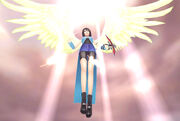
Affections Fly
Rinoa'south Limit Break, Angel Wing, has her sprout white feathered wings similar those of angels as depicted in most works. Angels and angel wings are Rinoa's motif, with her having the wings printed on the back of her duster, her dog'southward proper name is Angelo, her ultimate weapon is fabricated of interlocking white feathery wings, and she is associated with a single white plume, which she uses to seek out Squall who is trapped outside of time. Every bit a sorceress she is a mirror opposite of Ultimecia in many ways, and the latter'south blueprint may thus allude to that of a fallen angel.
Fujin alludes to a Japanese wind god. This is why Fujin is associated with current of air magic, and why she has the Guardian Force Pandemona. Raijin alludes the Japanese thunder god, and he uses thunder-based attacks, and is healed by thunder based attacks directed towards him. In Chinese Buddhism, a legend states that Fujin and Raijin were originally evil demons who opposed Buddha. They were captured in battle with Buddha'southward army of sky, and have worked as gods since then.
The Guardian Force Quezacotl is based on the Quetzalcoatl, one of the major deities in ancient Mesoamerican mythology. Quetzalcōhuātl means in the Nahuatl language "feathered ophidian". Due to the many civilizations worshiping the same deity using unlike names for it in the span of nigh 2,000 years, the exact attributes and significance of this god vary. Most stories hold upon Quetzalcoatl beingness the god of the morning star and being known every bit the inventor of books, the calendar and the giver of maize to mankind. The worship of Quetzalcoatl was, in some religions, connected with human sacrifices, while in others, opposed to them.
Final Fantasy IX [ ]
Freya Crescent is named afterward the Nordic goddess Freyja (lit. Lady), who amidst other things, was associated with war, magic, expiry, and love. Every bit a throwback to previous Final Fantasy games, the boondocks of Lindblum has a church building.
Final Fantasy 10 [ ]
Much of Final Fantasy X is based on the corruption of organized faith and the misuse of such faith to support an evil crusade. Yevon presents itself as Spira's saving faith, but comes apart equally a corrupted and manipulative religion centered on minimally appeasing the masses to maintain the status quo while committing heresies in the background. Yevon'southward downfall alludes to the religious skeptic's argument that organized religion is corrupt, and has its followers worshiping lies. Yevon resembles a theocracy; one that exercises authoritarian political ability, rather than solely administrating its doctrinal affairs. Like Last Fantasy Vii (which the developers confirmed existence connected to Final Fantasy X) there are strong Gnostic undertones to the portrayal of spirituality in Spira.
The Yevon Temple draws inspiration from many real-world religions, such as Shintoism (practices and temples), Buddhism (iconography and ritualistic disciplines), Islam (pilgrimages) and Catholicism (hierarchical structure and rigid doctrine). A most notable influence appears to exist derived from the faith of Jodo Buddhism, a branch of Buddhism centered on the doctrines and practise of Amitābha Buddha, where its founding story describes the monk Dharmākara ascending to Buddhahood and discovering the ability to establish a buddhakṣetra, a realm across reality founded past a Buddha's ain merits. Naming his earth the Pure Country and becoming Amitābha Buddha, he vowed to make his world a paradise to which all peoples of his faith can enter and transcend into Buddhahood with ease to assistance the rest of the globe.
Adapted into Japan, Jodo became pop with the common castes due to its simplicity in comparing to Shingon and Nichiren, and its influence reached into the Majestic Court; by the times of the institution of the Tokugawa Shougunate, Jodo had reached its loftiest height of power for over the bridge of 264 years. Many of Yevon'due south aspects, from its founder'southward backstory, its control over the world, and reign of influence, also tie in with the East Asian blueprint direction and Yevon'due south incarnation within the game.
Yevon comprises of leaders known as Maesters, which include Seymour Guado, Wen Kinoc, and Kelk Ronso. These positions are comparable to the Cosmic roles of cardinals, and Grand Maester Yo Mika's wardrobe resembles the Pope'south.
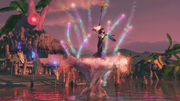
Yuna sends the souls of the deceased, as pyreflies, to the Farplane.
Yuna resembles a miko of Shinto religion, having been raised in the ways of her religion and travels to exercise good in the globe. To further the elements of Japanese religions, the pyreflies are based on the concept of human souls appearing equally fireflies.
Seymour Guado envisions himself as a messiah as he offers the promise of a better life for the people. His goals are more akin to the Hindu deity Shiva, intending to destroy everything to relieve information technology. He tin can be compared to a imitation prophet, every bit he preaches for unification all the same tricks the people of Yevon and plans to go Sin with the intention of destroying Spira. When he is killed he assumes a pose similar to how Jesus is oft portrayed on a crucifix. Seymour likewise goes on to "rise from the dead" by becoming an unsent.
Gnostics believed all humans have a fragment of divine calorie-free, corresponding to the pyreflies in Final Fantasy Ten, inside them. But by rejecting the cloth world and recognizing all life stems from the Pleroma/the Absolute tin the fragments render to the source (i.e. the Farplane), bringing their memories of life with them. This overlaps with Seymour's nihilistic worldview, in that he attempts to free people'southward souls from the hurting of life, though he attempts to kill them rather than enlighten them.
The Roman Catholic Church building persecuted the Gnostics every bit heretics, and the Gnostics' esoteric knowledge of how to return to the source of life was mostly eradicated, dooming the fragments of divine low-cal, in the Gnostics' eyes, to keep cycling (a key theme in Terminal Fantasy Ten) into the textile world. Similarly, the true nature of Sin and the destruction it wreaks was subsumed by the Yevonite church, who created a doctrine to fit their ideals, perpetuating their organization and, past extension, Spirans' suffering.
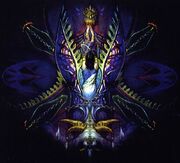
Anima'south fayth.
Gnostics believed in aeons, manifestations of the Absolute formed from its divine calorie-free, like how the aeons are made of pyreflies in Last Fantasy X. Ane of the aeons, Anima, is a concept of the eternal feminine in the psychology of Carl Jung, who was inspired by Gnosticism. The name "aeon" has its root in the Greek deity of the unending cyclical nature of time, "Aion".
Sin is a transgression of a religious or moral law, especially when deliberate. Yu Yevon created Sin as a bodyguard and for ability, thus exhibiting animalism, pride, and greed (and possibly more than): three of the Vii Deadly Sins. Sin may also be a representation of the Christian concept of "original sin", as the Maesters state it tin can never be vanquished because humanity will never be that pure. Thousand Maester Mika knows that worshiping Yu Yevon is bereft and that Sin will be reborn.
The summoner'southward pilgrimage is a religious one, whereupon the summoner prays to shrines of departed spirits to receive their protection equally spirit guides. The summoners are viewed as martyrs, a concept where one dies for their organized religion in the face of an enemy, concrete or spiritual, and is exalted for it.
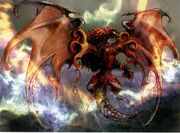
Valefor, an aeon.
Valefor is a demon in the ars goetia (demonology text list the names of all the demons and their orders). "He tempts people to steal and is in charge of a good relationship amidst thieves. Valefar is considered a good familiar by his associates till they are caught in the trap." He commands ten legions of demons, though her appearance in the game is unlike than the form in the aforementioned texts (king of beasts with the caput of a human or donkey). His description is reminiscent of the game in general, since the aeons are created by the fayth who, in turn, were created by Yu Yevon.
The story of Concluding Fantasy X has some allusions to Christianity. The Bible is separated into two primary parts: the Old Testament and the New Attestation. The first book of the Bible is Genesis. Following Creation, man (Adam and Eve) disobeyed God, introducing sin into the globe. Prior to the original sin death did not exist equally Adam and Eve could eat from the Tree of Life. After eating from the Tree of the Knowledge of Adept and Evil, the 2 were expelled from the Garden of Eden where the Tree of Life grew, and death was introduced to the world.
Decease existed prior to Sin in Final Fantasy X, but Sin brought with it the "spiral of death," the cycle of sorrow and demise; because of Sin, everything in Spira revolves effectually death.
The Crusaders are named for the legions of the Cosmic Church who fought the Muslims during the Crusades.
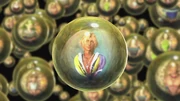
The fayth's dream parting from Spira.
"Fayth" is an obsolete spelling of the English word, "organized religion". It is believed to be an intentional use, giving religious undertones to the fayth who are referred to as "children of prayer" in the Japanese. The Siddham Sanskrit script, the ground for the script of Yevon, is used in Nihon mostly past the Shingon School of Buddhism that draws on early Hindu traditions.
One traditional concept is that deities manifest their thoughts or spiritual free energy in the concrete earth on several different "wavelengths": Sound, Form, and Symbol. The form through which a deity tin can manifest is an anthropomorphic representation that is not the deity itself, but a living course humans tin auscultate. The form physically expresses the deity's essence, in the same vein the aeons stand for the fayth's dreams rather than their temporal bodies. In some Hindu and Buddhist practices ane can invoke a deity through the concrete representation of a statue, like to the link between aeons and fayth. The fayth also sing the "Hymn of the Fayth", which may stand for the "Sound" part of the different ways deities manifest in the physical realm in Shingon Schoolhouse of Buddhism.
Concluding Fantasy 13 [ ]
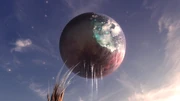
The floating earth of Cocoon.
The perspective of Cocoon's citizens onto Gran Pulse resembles the Christian perspective of the material earth, where information technology is said to be a corruptible and malignant place, "an illusion to the glory of Heaven" that is Cocoon. The view is paradoxical in how the basis of Cocoon may exist based on the Floating Globe of Japanese civilization, where hedonistic and material pleasures are sought, the thesis of John B. Cobb, where the priority of wealth is have said to have overtaken even the pursuit of God in the Western world, and how years of corruption in the Christian church have come to greed and hypocrisy; from abuse of power to wayward gospels centered on proceeds and power through faith and zealousness, from the Prosperity Gospel and Christian Identity.
Barthandelus in his guise as Galenth Dysley, tin can exist considered the Sanctum's version of the Pope while he is Primarch downwardly to similar attire and the use of purples and whites. This similarity is further highlighted in the Japanese versions, where he was called "K Pope". Ultimately, Barthandelus is more like a false prophet who manipulates events and people to suit his kind'due south needs.
The concept of fifty'Cie may allude to principles within Hinduism, Buddhism, Jainism, Sikhism, Bön, and other Indic religions. According to the principle of samsāra, life on earth is a expletive, and ideally a sentient being must ascend, over many lifetimes, to nirvāna, a more than ideal, though not earthly, state of being. The means of escaping samsāra are known every bit Atman, like a Focus. There are many paths to ascension, although information technology is never conspicuously stated which one a person must take. One of them is alluded to in Oerba, with Vanille'southward robot Bhakti. Bhakti comes from the give-and-take bhakta (love) and refers to the idea that one way to achieve salvation is through personal devotion to a deity (fal'Cie).
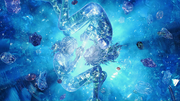
Fang and Vanille crystallized after summoning Ragnarok.
The idea of Ragnarok originates from the terminal war mentioned Norse mythology where the globe is destroyed with only a handful of survivors, both divine and immortal, who repopulate the world as it is reborn. The characters of Fang and Vanille are based on the Ragnarok myth of Líf ("life") and Lífþrasir ("eager for life")—the humans who volition survive Ragnarok, who sleep through globe'south destruction and upon awakening volition find the earth verdant over again. Líf and Lífþrasir will become the progenitors of a new race of humans, and their descendants will inhabit the earth. This is congruent with the thought that Fang was originally envisioned every bit a male character.
The idea of Ragnarok is thematically revisited in Final Fantasy XIII-2 and Lightning Returns: Final Fantasy XIII, with the merging of Gran Pulse and Valhalla marking a wearisome pass up of the world and Lightning existence tasked to guide the survivors to the new world that is near to exist born.
The utilise of the Ark seems to differ from its religious use. According to globe myths, a groovy flood was set to occur by a vengeful god. Disappointed in his creations, he planned to wash everything abroad to make way for a new historic period. The god deemed one of his creations pure and deserving a place in the new world free of evil, and and then warned this person. In Abrahamic theology, this homo was Noah, and in Mesopotamian tradition, he was called Uta-Napishtim, too as Atrahasis and Zisudra amidst others around the world.
A floating ark in Last Fantasy XIII-ii.
The man was told to create an Ark capable of carrying animals and the man's family unit upon the drench. The humans did as they were told and survived the flood that destroyed all other state-life. As a reward, these patriarch were either promised by God never again to destroy the Globe past alluvion, or were given immortality for saving lives from the ending.
In Final Fantasy Thirteen, the Arks are armories filled with living weapons in stasis, ready for the war on the Day of Reckoning. The Fabula Nova Crystallis: Concluding Fantasy mythology infers that the Arks were designed for the war between Bhunivelze and Mwynn, once the unseen gate to Mwynn's residing place would be found.
Orphan is named later the Ophanim, a choir of angels described in Ezekiel'south vision every bit fiery wheels covered in eyes, a description approximated past Orphan's blueprint.
Orphan and the other fal'Cie's motives of getting the creator to return by destroying the globe alludes to one theory within deism, popularized by Voltaire, that claims that God was like a clockmaker who wound the clock then left information technology on its ain.
Terminal Fantasy Xiii-two [ ]
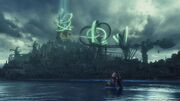
Valhalla.
In Norse mythology, Valhalla was a majestic hall in Asgard, where the gods and half of those who died in combat dwell. Information technology was ruled by Odin, who appears equally Lightning'south Eidolon.
In that location is an NPC who quips, "Demand an ark? I Noah guy!", a reference to the Biblical story in which a man names Noah builds an ark at God'due south command and places two of each blazon of creature inside it to guard against their extinction due to a cataclysmic flood about to be unleashed by God.
Noel and Yeul have their names derived from French and alternate English proper name for Christmas, respectively. Yeul beingness continually reborn refers to the Hindu concept of samsara while playing on the resurrection of Jesus Christ with whom Christmas is directly connected with.
Lightning Returns: Last Fantasy XIII [ ]

Lightning saves Snow'southward soul as the savior.
Various Lightning Returns: Final Fantasy 13 aspects are based on Norse mythology. As alluded to in Last Fantasy 13, the world will end in a bang-up battle chosen Ragnarok, killing numerous gods, triggering many natural disasters, and a globe-spanning world war. After Ragnarok the world will be reborn, and the surviving gods and mortals will bring together to rebuild civilization in the new world.
Bhunivelze'southward matricide and banishing Mwynn to Chaos to supersede her position bears some similarities to the Greek myths, more specifically how the Olympian Gods overpower their Titan predecessors, particularly Cronus (Saturn in the Roman myths) and have control of the mortals. He is called the God of Light, bearing some resemblance to Lucifer (Satan), known equally the Lite Bringer. Lightning and the souls of humanity casting Bhunivelze into the unseen realm in the explosive fires of the apocalypse also resembles Satan's ultimate fate in the Book of Revelations where he is cast into a lake of fire. Bhunivelze'due south partial crystallization immediately before the final blow also resembles how Satan was trapped waist down in a frozen lake in Dante'south Divine Comedy. The concepts of a world destined to end, a world divided between the mortal realm and an invisible earth of the afterlife, and a defeated goddess hiding in that invisible earth, are too reminiscent of the Japanese Shinto creation myth.
Lightning is given the role of the savior, to shepherd souls to a new world. She is given the use of the Ark on Promise's Bhunivelze, in which to rest and release the souls of those she has saved. On the eve of the Apocalypse Fang and Vanille guide the souls of the dead to the Ark to escape the stop of the world and expect for their take a chance of being reborn in the new world.
The Soulsong and Vanille'southward intended use as a sacrificial offering tin be compared to ritual purification and Jesus Christ'southward part as the Lamb of God, whose sacrificial death as a servant of God purged humanity's sins and purified them. Every bit followers of Bhunivelze, the Society of Conservancy sought to use Vanille as a sacrificial lamb and take her die in a ritual to destroy the dead and 'purify' the living of their burdens in preparation for rebirth in Bhunivelze'due south new globe.
Final Fantasy Fourteen [ ]
There are 2 deities: Hydaelyn and Zodiark. While Hydaelyn tin can be seen equally a Globe Mother-blazon goddess, linked to the aether, Zodiark is a slumbering deity whose revival is existence sought by the Ascians through the primals. Needing to be worshiped like gods, sometimes manifested in the forms of deceased ones, or a fictional effigy equally in the case of Bahamut and Skillful Rex Moggle Mog XII, the primals prolong themselves on faith and aether, which weakens Hydaelyn as a consequence. In that location are besides those who tin transform into central forms, similar Ysayle Dangoulain and King Thordan.
While the Garlean Empire is not shown much, many amidst its invasion forces express a denouncing view on the divinities worshiped by residents of Eorzea to the point of committing iconoclasm every bit seen with Gaius van Baelsar.
Additionally, natives of Doma announced to worship an analogue of Shinto, equally Oboro will explain to a budding Ninja that the gods of the Domans are all around them—"in the copse, in the soil, in the crashing waters before you."
Final Fantasy Xv [ ]
Terminal Fantasy XV has diverse themes involving the boxing between forces of light and darkness and life and death. Final Fantasy XV tin be interpreted to take allusions to Abrahamic religions, Buddhism, and Shintoism, among others, most presently Noctis Lucis Caelum's journey as a messianic figure.
Final Fantasy Tactics [ ]
A major antagonistic organization is the Church of Glabados, an innuendo to the one-time Roman Catholic Church and the infamous Medieval Inquisition. The Church'south Messiah, St. Ajora, alludes to Jesus Christ, although his deportment were closer to that of a faux prophet or the Antichrist. His comparison to a false prophet was indicated by his job class, "False Saint" or "Phony Saint".
Germonique's betrayal of St. Ajora to the proper government, exempting the more noble reasons behind the betrayal, were similar to Judas'southward expose of Jesus Christ to Pontious Pilate. The Lucavi, who possess humans upon expiry, refer to demonic possession. The Lucavi are explicitly referred to as demons, and their leader, Ultima, a fallen affections.
Final Fantasy Type-0 [ ]
The globe of Orience is stuck in a spiral of destruction and rebirth with the memories of past events beingness purged from the living. The world ends during Tempus Finis when the Rursan Arbiter, too known as the "Judge", deems whether an Agito has been born into Orience: if at that place is no Agito, the Judge commences the cease of the world. This is akin to the Terminal Judgment, role of the eschatological world view of the Abrahamic religions and in the Frashokereti of Zoroastrianism. In Christian theology, it is the terminal and eternal judgment by God of the people in every nation resulting in the glorification of some and the penalization of others. The Judge resides in Pandæmonium, whose name derives from the castle of Lucifer and the capital of Hell in John Milton's Paradise Lost.
Within Buddhist cosmology, the highest point of the mortal world is the Deva Realm, and its highest region is the Sixth Heaven. Seemingly a juxtaposition to mankind's traditional depiction of heaven throughout the world, the Deva Realm is said to be a identify of countless indulgence and the Sixth Sky is populated by demons and their leader Mara, the antithesis of Buddhist virtues who represents the negative aspects of the fleeting material globe. Along with victimizing and agonizing mankind corporeally, Mara and his demonic followers control mankind through their desires for their ain ends. Mara created the Desire Realm where the world of men is located, and is the primary of its domain, in command of its illusions, sensual manifestations, and abstractions to misguide and corrupt its denizens in the unending cycles of karma and suffering. Able to resist and counter Mara'due south presence within one's life is one purpose of the Dharma and Buddhist Virtues, every bit transcending the Desire Realm leads 1 into Nirvana to be freed from these cycles and the malefic influence of Mara.
While Buddhism teaches mercy and compassion, and to comprise virtue in the face of life's challenges, Buddha'southward teachings are not the only definite way, and one must achieve their own salvation within the course of their own lives. Buddhism's Middle Style is that of balance, including non being overtly indulgent simply in the good things and to be expedient to others and oneself to assistance realize the fashion of i'south enlightenment. Although Orience's alternating history sees the 2d Orience War never occurring with an age of peace in its stead, such a timeline implies other unfortunate implications, such equally ignorance of the threat of Bhunivelze and the destruction of Mwynn'southward universe in the wider scope of things. Through realizing the farce of the Crystals' desire to unify Orience through world wars to notice the Agito, even subsequently 6 hundred million cycles Course Nada fights without the temptation of becoming l'Cie to free Orience from the selfish diplomacy of the Fabula Nova Crystallis gods.
Final Fantasy Adventure [ ]

The Star of David appears on the magic circle in Wendel, but was modified to an octagram in the North American and European versions.
Spoilers stop hither.
Source: https://finalfantasy.fandom.com/wiki/Religious_allusions_in_Final_Fantasy
0 Response to "The King of the North According the Bible Fantasy Art the Bear"
Post a Comment